

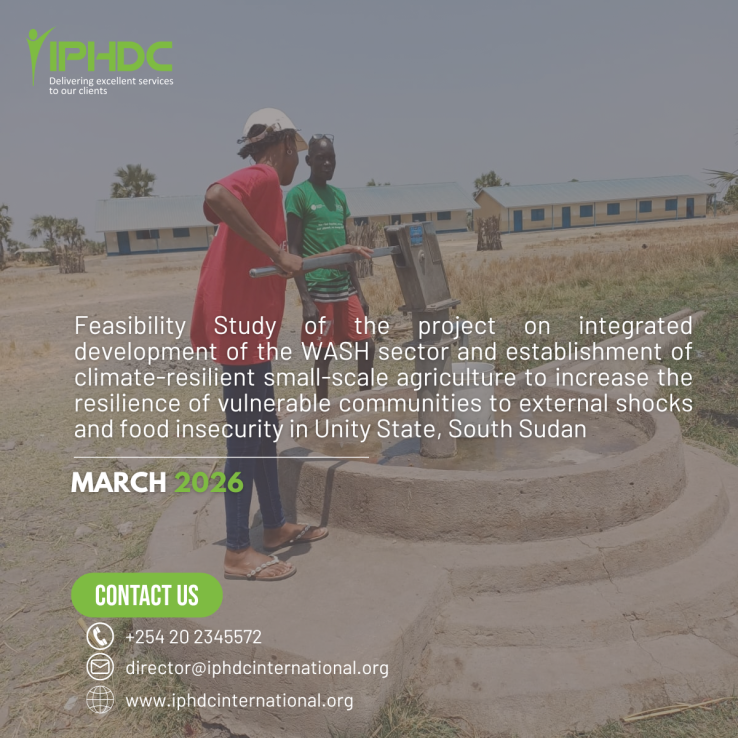
Project Feasibility Study | March 2026
Before submitting the full project concept document and German Federal Ministry for Economic Cooperation and Development (BMZ) funding application, Sign of Hope (SoH) — Hoffnungszeichen e.V. — commissioned this feasibility study to provide a robust, field-validated evidence base for design decisions, to confirm whether the proposed project can plausibly achieve its objectives given current contextual realities, and to support quality assurance before funding commitment. The commissioning of an independent feasibility study is not only good practice — it is a BMZ/bengo requirement for projects at this funding scale.
This feasibility study was undertaken by IDEAL Public Health and Development Consultancy (IPHDC) in March 2026 in collaboration with Universal Intervention and Development Organization (UNIDOR) which is the implementing agency and SoH the technical supporting partner for this three-year project funded by BMZ. The study covered five counties in Unity State, South Sudan. The project targets 2,500 households — approximately 15,000 people — across all five counties (average household size of 6 persons, consistent with Unity State demographic data). The target population is primarily Nuer in Unity State and Dinka (Panaruu and Paweny sections) in Ruweng AA, living in scattered villages depending on subsistence farming, fishing, livestock rearing, and petty trade.
The study applied a two-tiered methodological structure that separates evidence generation from analytical synthesis thus ensuring rigor, triangulation, and structured feasibility conclusions. A total of 25 recommendations were given touching on project design adjustments, budget and financial adjustments, capacity strengthening and stakeholder engagement.
The feasibility study confirmed the proposed integrated WASH, climate-resilient agriculture and livelihoods project as feasible, evidence-validated, and appropriate for BMZ funding approval. The evidence base — 64 FGD community participants, 14 key informants, 3 site assessments, and comprehensive desk review — supported this verdict across all six OECD/DAC criteria.
Comments